On March 12, 2025, a trader swapped 732,583 USDC and walked away with 18,636 USDT. Not a rug. Not a hack. A market order with 100% slippage tolerance broadcast openly to the public mempool and sandwiched six separate times.
This wasn't bad luck. It was a predictable outcome of applying CEX thinking to a DEX.
The "market order vs. limit order" framework you learned on a centralized exchange was built for a specific machine, a central order book where bids and asks rest, get matched, and execute at price-time priority. That machine does not exist on an AMM. When you carry that vocabulary onto a decentralized exchange without understanding what's actually running underneath, you're flying on instruments calibrated for a different aircraft.
Here's what's actually happening, and why it matters.
What a "Market Order" Actually Is on an AMM
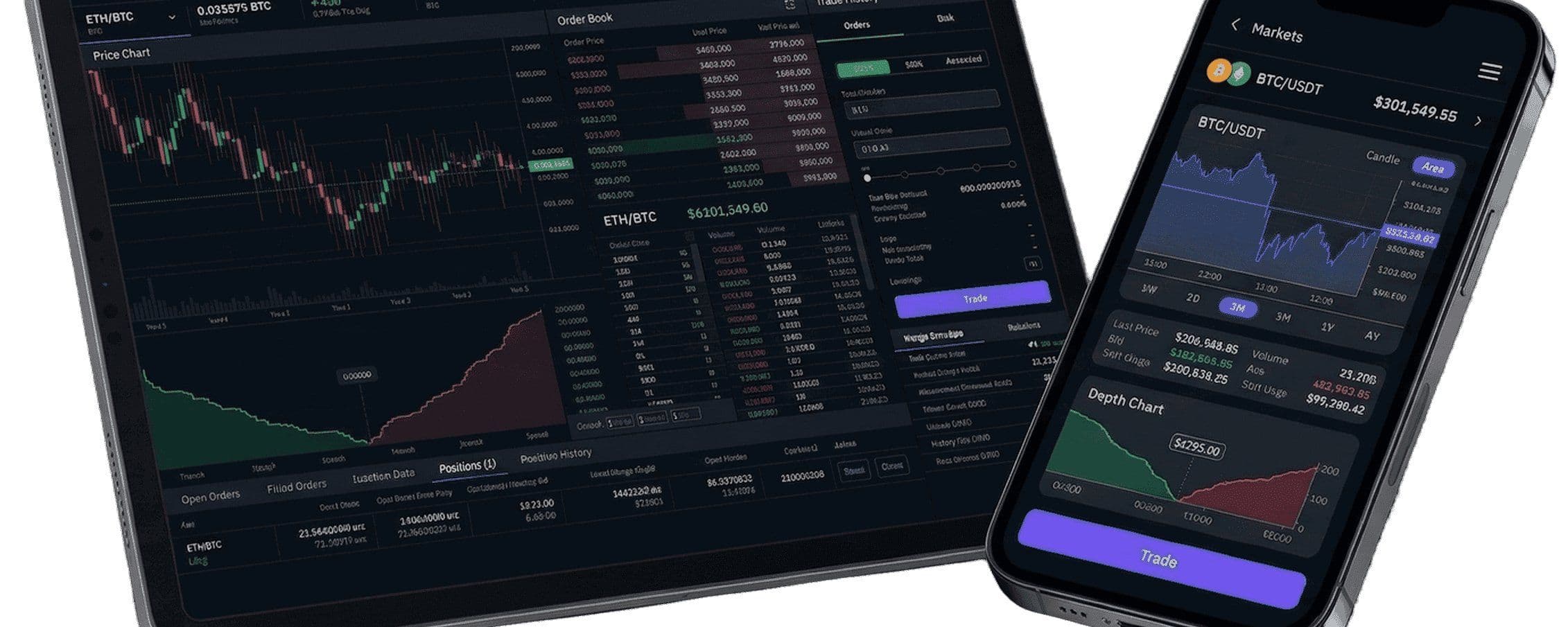
On a CEX, a market order walks the order book: it matches against the best available resting bid or ask until filled. There's a book. There are counterparties. Price discovery is continuous.
On an AMM, none of that exists. Every swap, whether you think of it as a "market order" or not, is a single take against a mathematical pricing curve. A standard constant-product AMM uses the formula x * y = k. Concentrated liquidity AMMs segment that curve into tick ranges, allowing tighter depth at specific price bands. Stableswap AMMs use a different invariant optimized for near-peg assets, such as stablecoin pairs.
When you hit "swap," your transaction is queued in the public mempool, waiting to land in a block. Two things are now working against you:
Price impact is the change your own trade size makes to the pool price, deterministic at quote time. On a pool with 100 ETH and 300,000 USDC, selling 1 ETH moves the marginal price by roughly 1%. On a concentrated liquidity pool with $10M TVL, the real in-range depth at your specific price band might be only $50,000 so your trade walks through multiple ticks at progressively worse prices, and the quote you saw at signing is already stale.
Slippage is the change caused by everything else that lands in the block ahead of you: other users, arbitrageurs, and most dangerously, bots that specifically target your transaction. This part is not in your quote. It's a tax extracted from you in real time.
The combination of these two is what makes a market order on a low-liquidity pool genuinely dangerous, not a theoretical risk but a quantifiable line item.
The MEV Tax You're Paying on Every Market Swap
MEV or Maximal Extractable Value is the profit miners and validators (and the bots that work with them) can capture by reordering transactions within a block. On a DEX, the dominant MEV strategy is the sandwich attack: a bot detects your pending swap in the mempool, buys the asset ahead of you (pushing the price up), lets your trade execute at the inflated price, then immediately sells (pushing the price back down). You pay the spread; the bot pockets it.
The scale of this is not trivial.
ESMA's July 2025 Technical Report on MEV in crypto markets quantified 2025 Ethereum MEV volume at $561.92 million, with sandwich attacks accounting for $289.76 million representing 51.56% of total MEV. According to Cointelegraph Research's analysis of EigenPhi data covering November 2024 through October 2025, roughly $60 million was extracted from Ethereum users across 95,000+ sandwich attacks, with approximately 70% of those attacks traced back to a single bot wallet: jaredfromsubway.eth, which has accumulated more than $22 million in cumulative sandwich profit since March 2023.
The $220,764 USDC to USDT sandwich case from March 2025 is particularly instructive. The attacker paid a $200,000 tip to an Ethereum block builder and walked away with only $8,000. The builder and not even the sandwich bot captured most of the extracted value. This is the current state of MEV economics on Ethereum: a competitive extraction market where even the attacker is being extracted from.
Solana's numbers tell a different story but not a better one. Research from sandwiched.me for October 2025 counted more than 202,000 victims and approximately 18,000 SOL extracted in a single month. One bot ran 82,000 sandwich attacks in a 30-day period in April 2025, targeting 78,800 victims, for 6,900 SOL net profit. Peak day: 4,925 attacks and 4,002 victims. On some Solana validators, the sandwich rate on transactions exceeds 20–60%.
If Vitalik Buterin, who doesn't set extreme slippage, knows what a mempool is, and understands AMM mechanics, got sandwiched on a routine token swap in May 2026, the attack surface is not a beginner's mistake. It's structural.
What a "Limit Order" Actually Is on a DEX (It Depends on the Venue)
Now the part most articles skip: on a DEX, the phrase "limit order" refers to at least four structurally different mechanisms, and three of them can fail in ways no CEX limit order ever could.
1. Off-chain signed intent (Intent-Based Execution)
You sign a message off-chain expressing your intent: "I want X token, I'll accept no worse than Y price." A network of fillers or solvers competes to fill your order, routing through AMMs, private inventory, or other liquidity sources. The best solver wins via a Dutch auction or request-for-quote process. You pay no gas on signing. MEV is internalized by the filler and partially returned as price improvement.
This is the cleanest DEX execution model available today. The failure mode isn't the fill itself but rather filler economics on illiquid pairs and the fact that "cancellation" is just an unsigned message, not an on-chain action.
2. Concentrated Liquidity Range Order (Single-Tick LP Position)
This is what happens when traders try to replicate CEX limit orders using a concentrated liquidity AMM, depositing into a single tick range just above or below the current price. When price enters your range, your position converts from one asset to the other, approximating a limit fill.
The critical failure mode is almost never mentioned in trading guides: a range order will go unfilled if the spot price crosses your range and then reverses before you withdraw the converted asset. If you set a buy range at $1,800 ETH, price touches $1,798, and then bounces back to $1,850 before you withdraw, you now hold a position that got partially converted and back again, earning LP fees on both crosses, but you never got your clean limit fill. You also bear the full "free option" cost: if ETH crashes from $1,800 to $800 on bad news, an arbitrageur picks off your position before you can pull it.
3. Keeper-Monitored Off-Chain Order
Your order is signed and stored off-chain. A keeper bot monitors the price feed and executes the fill on-chain when your target price is reached. This model is closest to a traditional limit order conceptually.
The failure mode is structural: keepers may not always fill even when the target price is reached, because the system depends on liquidity availability at that exact moment and keeper bots catching the price in time rather than an order book. On high-volatility assets, a 30-second wick can print your target price and reverse without any keeper catching it. The liquidity that would have filled your order evaporated in the same wick.
4. On-Chain Central Limit Order Book (CLOB)
Here, finally, the CEX vocabulary maps cleanly. A true central limit order book runs on-chain with price-time priority, post-only flags, IOC, TWAP, and reduce-only orders, the full suite of order types that professional traders expect. Some on-chain CLOB implementations achieve sub-second order finality with throughput high enough to support serious trading activity.
A resting limit order on an on-chain CLOB behaves like a resting limit order on a centralized exchange because it's architecturally the same construct, just running on a decentralized validator set.
The distinction matters enormously: the "will my limit order fill on a wick?" problem does not exist on a CLOB. It's a keeper/AMM problem, not a limit order problem.
The Seven Misconceptions That Cost Traders Real Money
"Limit orders on DEXs are free."Off-chain and keeper-based limit order systems recover costs through platform fees or filler spread typically hidden in the quoted output amount rather than shown as a line item. The cost is real; it just doesn't look like a commission.
"My limit order will fill if price touches my target."Only on a CLOB. On keeper-based systems, the fill requires available liquidity at that price and a keeper catching it in time. On concentrated liquidity range orders, a wick that reverses before you withdraw means no fill and only unintended LP exposure.
"Limit orders have no slippage."True on a CEX. Not true on DEX implementations that route final settlement through AMM pools. The fill touches a curve, and if the pool is thin, price impact applies to your "limit" fill. Some implementations can still be sandwiched because the final execution is an AMM swap.
"Market orders are safe for small trades."On thin memecoin pools, a $200 swap can lose 5–15% to combined price impact and MEV. Pool depth at your exact price range is the variable that determines this, not your trade size in absolute terms. A $200 trade on a $3,000 TVL pool is enormous.
"I need a market order to execute quickly."Intent-based DEX aggregators typically settle within the same block window as a regular AMM swap, with MEV protection built in. There is no speed advantage to an unprotected market swap broadcast to the public mempool, only a cost advantage to the bots watching it.
"Native ETH works for limit orders."Every off-chain limit order protocol on Ethereum requires wrapped ETH (WETH). Native network tokens must be wrapped before they can be used in most DEX limit order systems. Forgetting this forces you to wrap mid-trade, by which point the price has moved.
"MEV is solved now."Average per-attack sandwich profit on Ethereum has compressed to roughly $3. But aggregate extraction is still ~$60 million annually across 95,000+ attacks. The per-attack economics got competitive; the aggregate user loss did not shrink. On Solana, extraction is accelerating, not decelerating. Private RPCs help but don't eliminate the risk as a December 2024 academic study documented 2,932 private-channel sandwich attacks against supposedly protected transactions, producing $409,236 in losses. The risk moved; it did not disappear.
What to Actually Do
The practical decision isn't "market vs. limit." It's which execution venue fits the trade.
For larger swaps on Ethereum, the default should be an intent-based DEX aggregator, which is gasless on signing, MEV-protected by design, and typically matches or beats raw AMM pricing because solvers compete for your order. There is no rational argument for broadcasting a large swap into the public mempool when these alternatives exist at effectively the same cost.
On Solana, use a DEX aggregator with calibrated slippage, targeting 50–100 basis points for liquid pairs and 200–300 for volatile small-caps. MEV protection tip bundles on Solana cost fractions of a cent per transaction in practice. Set slippage conservatively and accept failed transactions rather than raising tolerance to force a fill.
For a genuine resting limit order that actually behaves like a CEX limit order, use a DEX with an on-chain CLOB. Do not use concentrated liquidity range orders as a limit order substitute unless you understand the self-reversal mechanics and are prepared to monitor the position actively.
Never raise slippage tolerance to push through a stalled transaction on a volatile asset without checking the pool's real depth at that price. The $732,583 to $18,636 loss happened because someone set 100% slippage tolerance and broadcast six separate attempts into the public mempool. Each one was a sandwich invitation with a bow on it.
If you are trading on a public mempool chain without a private RPC endpoint active, you are paying the MEV tax on every single market swap. Enabling one takes under two minutes.
The Real Frame
The CEX model has two primitives: market order and limit order. The DEX ecosystem has four fundamentally different execution venues namely AMM swap, intent-based auction, keeper-monitored order, and on-chain CLOB, each with different guarantees, different failure modes, and different cost structures.
Mapping the CEX vocabulary onto the DEX landscape without understanding the underlying mechanics is how you end up swapping $732,000 and walking away with $18,000. The order type wasn't the problem. The execution venue was.
Know what's running underneath your trade. The block doesn't care what you called it.